

 English
 中文简体
中文简体 Español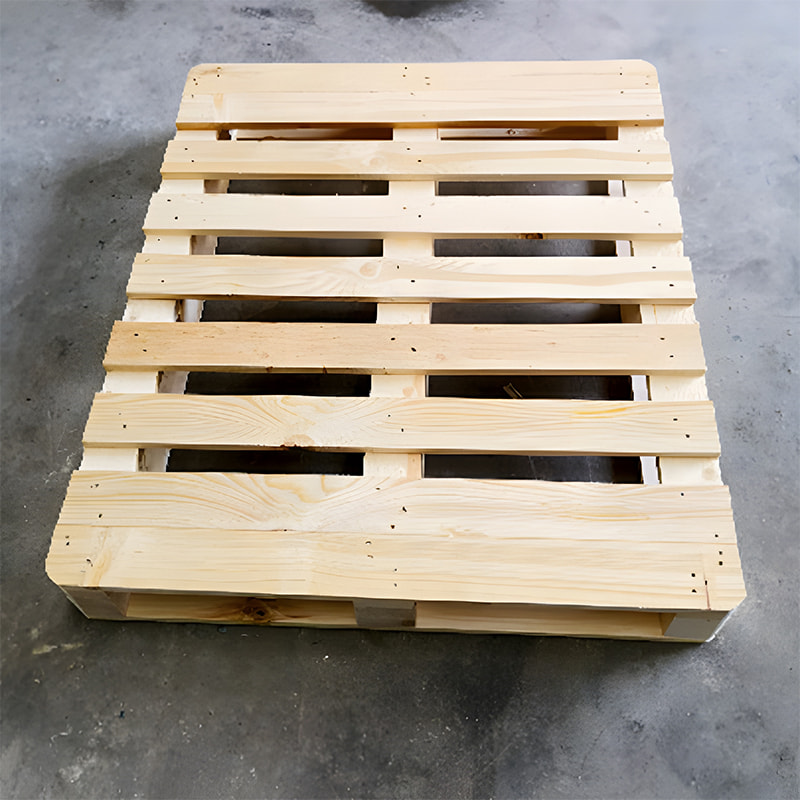
King Good Packaging Materials (NanTong)Co.,Ltd. is a Custom American Standard Plywood Pallet Manufacturer and American Standard Plywood Pallet Factory, committed to becoming a national OEM manufacturer of wood products packaging, specializing in the design, development and production of wood products. It has processing factories of different scales in Taizhou, Jiangsu Province, Fengxian, Shanghai, Wuhan, Hubei Province, Dongguan, Guangdong Province, Kunshan, Jiangsu Province and Beilun, Ningbo. The company's headquarters is located in Yazhou Town, Haian City, Nantong City. Since the establishment of the factory, it has newly introduced wood processing machinery and supporting equipment, and has technicians with many years of rich experience. It strictly controls each production procedure and ensures quality and quantity with proficient skills. We have formed a complete chain covering production, after-sales service and on-site packaging. Our perfect service has won high praise from many enterprises.
Based on raw materials such as fir, pine, miscellaneous wood, plywood and particleboard, KingGood can customize different products according to development to avoid unnecessary losses during long-distance transportation. Main products: Packaging boards, multi-layer boards, (for export and domestic use) wooden pallets. Wooden crates, pallet boards, front boards, and side board wooden crates (plywood, pallets, and packaging boxes can be exported directly without inspection, saving you a lot of cumbersome procedures) can provide packaging for extra-large mechanical equipment. Our company adheres to the principle of keeping promises, achieving mutual benefit and win-win results, getting along harmoniously, doing things with dedication, and providing excellent service. Ensure the company's continuous and stable development.


Plywood Pallet
All Products
American Standard Plywood Pallet
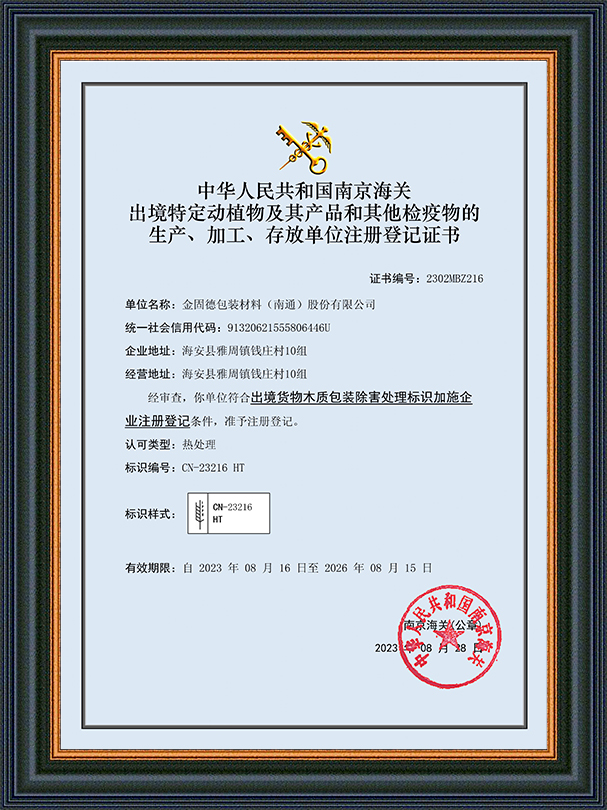
American standard plywood pallets are constructed from multi-layered veneer sheets that meet US pallet design standards and are pressed under high temperature. They are combined with environmentally friendly adhesives that comply with US environmental regulations, meeting strict US formaldehyde emission requirements, ensuring material safety and adapting to the US market's indoor air quality requirements. These pallets strictly adhere to the quarantine regulations of the US Animal and Plant Health Inspection Service (APHIS). After undergoing professional heat treatment and affixed with a special marking, they can enter the US market without additional fumigation. They also meet the additional flame retardancy and moisture resistance requirements of some US industries. They utilize standard dimensions commonly used in the US market, but can also be customized to meet specific US industry requirements. The four-way forklift design accommodates US forklift operation, metal reinforcements are installed in key areas, and rounded corners meet US occupational safety standards.
This pallet offers high load-bearing capacity suitable for US logistics applications, remains stable in diverse North American climates, and withstands low temperatures and humidity fluctuations. Prior to shipment, it undergoes factory-qualified US inspections to ensure reliability during stacking and handling. Widely used in US cross-border trade, manufacturing warehousing, and e-commerce logistics, it can carry a wide range of goods, including automotive parts, electronic equipment, and food and agricultural products. Compared with ordinary pallets, its core advantage is that it directly meets the US market access requirements, eliminating the additional quarantine process for cross-border customs clearance, while avoiding the problems of insect infestation and deformation of traditional solid wood pallets. The recyclable material complies with US environmental protection policies, can effectively improve the efficiency of connecting with the US supply chain, and reduce the company's cross-border logistics costs.
About KINGGOOD
King Good Packaging Materials (NanTong)Co.,Ltd.
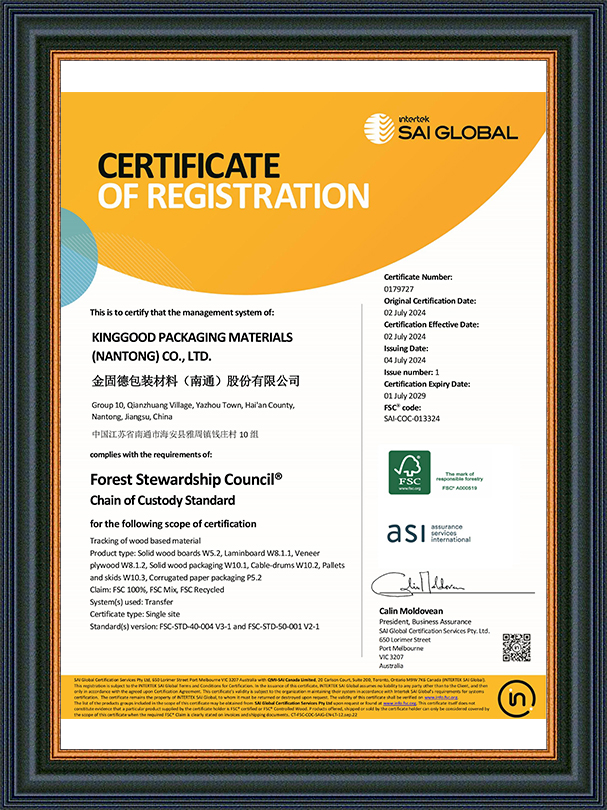
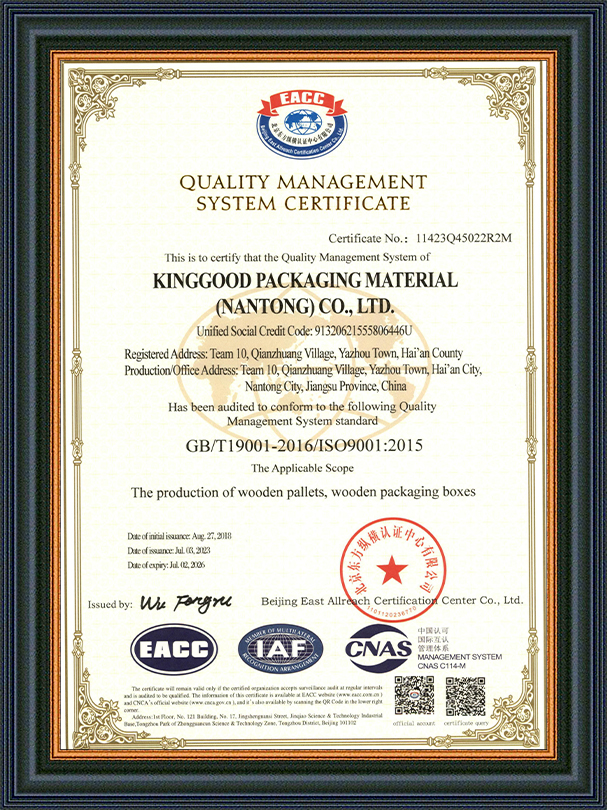
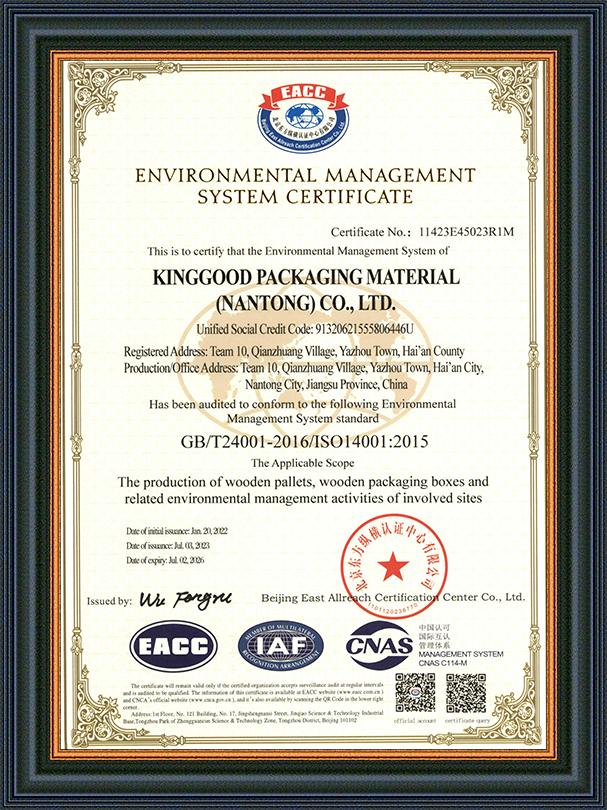
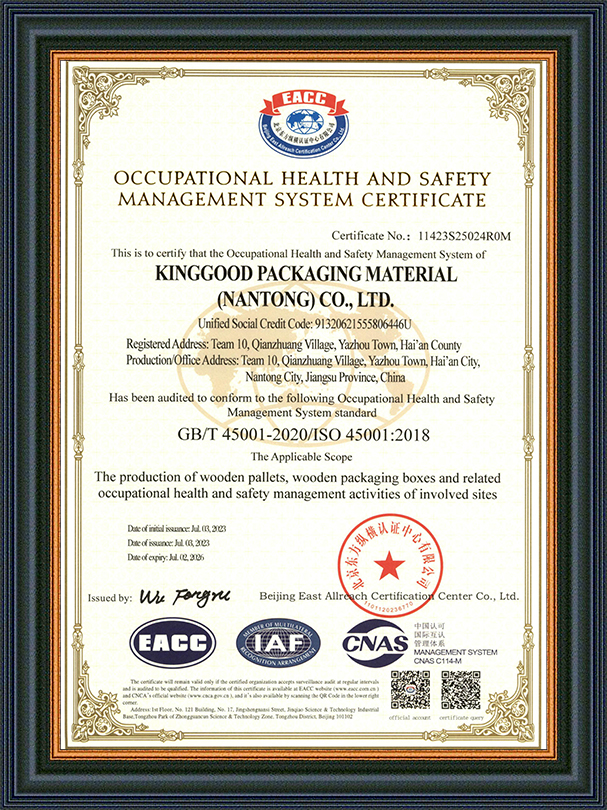
Certificate Of Honor

Message Feedback
Latest Articles

Plywood Pallet Industry knowledge
Why an American Standard Plywood Pallet Combines Fit and Efficiency
An American Standard Plywood Pallet pairs the footprint that U.S. warehouses and racking systems are already built around with the lighter, more dimensionally stable deck that plywood offers over solid sawn boards. For exporters shipping into the United States, this combination avoids two separate problems at once: pallets that don't fit standard racking, and pallets that add unnecessary freight weight to every shipment.
Choosing a plywood-decked pallet built to American standard dimensions offers several practical benefits:
- Direct compatibility with standard U.S. rack beams, conveyors, and pallet jack equipment, avoiding handling delays at the destination.
- Lower shipping weight than an equivalent solid wood pallet, helping control freight cost on high-volume export orders.
- Better resistance to warping under the humidity swings common during ocean transit, thanks to plywood's cross-grain construction.
- A smoother deck surface that reduces the risk of snagging shrink wrap or damaging cartons stacked directly on top.
How These Pallets Are Built to the American Footprint
Matching the GMA Footprint
The most common American pallet footprint measures 48 inches by 40 inches, a size known as the GMA standard, developed by the Grocery Manufacturers Association and now used broadly across U.S. warehousing and retail distribution. Building a plywood deck to this exact footprint ensures the pallet fits directly into existing racking and trailer loading patterns without modification.
Plywood Deck Over Timber Stringers
Rather than using individual solid boards, the top and bottom decks are built from full plywood panels fastened to timber stringers or blocks. This construction spreads point loads across a continuous surface rather than through the gaps between individual boards, which can reduce the risk of smaller cartons tipping or catching at deck seams.
Stringer Spacing for Load Support
Stringers beneath the plywood deck are spaced to match the expected load weight and forklift entry pattern, whether two-way or four-way access is required. Correct stringer spacing prevents the plywood panel from flexing excessively under concentrated point loads during lifting.
Plywood vs. Solid Deck: Choosing for U.S.-Bound Cargo
Even within the same American standard footprint, deck material choice affects weight, cost, and handling performance differently depending on the cargo being shipped.
| Factor | Plywood Deck | Solid Board Deck |
|---|---|---|
| Weight | Lighter for the same footprint | Heavier |
| Surface uniformity | Continuous, smooth surface | Gaps between individual boards |
| Humidity resistance | Better, due to cross-grain layers | More prone to single-plank warping |
| On-site repair | Panel replacement needed | Individual boards easily swapped |
Wood-based pallets used in international shipments generally fall under the ISPM 15 phytosanitary standard, which requires heat treatment or fumigation before export. Pallets already treated to this standard can move through U.S. customs without additional inspection.
Frequently Asked Questions About American Standard Plywood Pallets
Q1: What size is the American standard plywood pallet built to?
Most are built to the 48 inch by 40 inch GMA footprint, the size most widely used across U.S. warehousing, retail distribution, and trucking networks.
Q2: Why choose a plywood deck over individual solid boards?
Plywood offers a lighter, more continuous surface that resists warping better than single-plank boards, while still providing reliable support when paired with correctly spaced stringers.
Q3: Is a plywood pallet as easy to repair as a solid board pallet?
Not quite. Individual solid boards can be swapped one at a time, while a damaged plywood deck typically requires replacing a full panel section rather than a single board.
Q4: Do American standard plywood pallets need export treatment?
Yes, wood-based pallets shipped internationally generally require ISPM 15 heat treatment or fumigation before they can clear customs.
Plywood Pallets Built to U.S. Standard Specifications
Headquartered in Yazhou Town, Hai'an, Nantong, King Good Packaging Materials (Nantong) Co., Ltd. operates processing facilities across multiple regions, including Taizhou, Fengxian in Shanghai, Wuhan, Dongguan, Kunshan, and Beilun in Ningbo, producing American standard plywood pallets alongside solid wood pallets, wooden crates, and packaging boards. With strict process control across production, after-sales service, and on-site packaging, the company helps exporters shipping to the U.S. market balance freight weight, durability, and reliable rack compatibility.


Got Questions? Contact Us Now
-
Copyright @ King Good Packaging Materials (NanTong)Co.,Ltd. All Rights Reserved. Custom American Standard Plywood Pallet Manufacturer American Standard Plywood Pallet Factory

-
Contact info.
+86-0513-88669885 +86-13813749256 13813749256@163.com Qianzhuang Village, Yazhou Town, Hai'an City, Nantong City, Jiangsu Province, China - About KINGGOOD Packaging Series Industry Solutions OEM Service News Contact