

 English
 中文简体
 Español


Delicate Equipment Packaging: How to Choose Crates, Cushioning and Export Rules
Most damage to delicate equipment starts before the first board is cut. It starts when a crate is picked from habit: a plywood box because one was used last year, or a solid wood crate because the machine simply looks heavy. The crate then reaches the packing bay, the crew fills the leftover space with whatever foam is on the shelf, and everyone hopes the carrier will handle it gently.
Reverse that order and the result improves at once. Define the transport profile first: how the unit will be lifted, how many times it will change vehicles, how long it will sit in a humid port, and which wood-packaging rules apply at the destination border. Then size the cushioning gap against the fragility of the frame and the mass of the load. Choose the enclosure family last, when the forces it has to resist are already written down. A crate is the output of that analysis, not a replacement for it.
Content
- 1 Which Crate Type Fits Which Delicate Load
- 2 Five Steps That Turn a Fragile Machine Into a Specified Pack
- 3 Numbers That Decide Whether a Cushion Actually Works
- 4 Three Cushioning Techniques Worth Specifying
- 5 Common Mistakes and What They Cost
- 6 Pre-Shipment Checklist for Delicate Equipment
- 7 Handling and Compliance Notes That Protect Your Claim
Which Crate Type Fits Which Delicate Load
| Crate type | Structure | Best-fit load | Main watch-out |
|---|---|---|---|
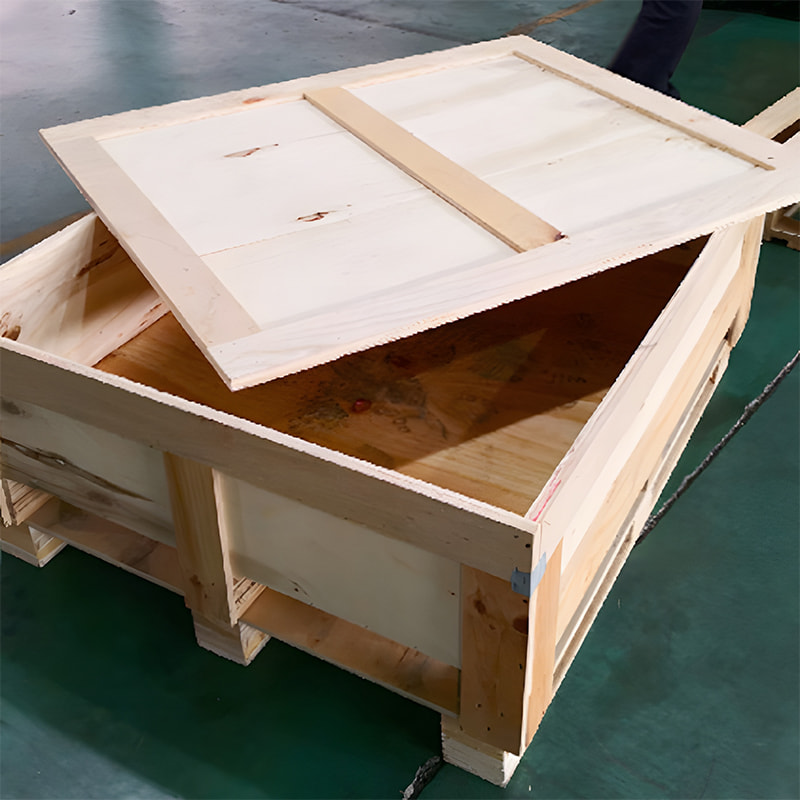
| Closed plywood box | Panels fixed to a plywood base | Mid-weight machines and instruments on controlled export routes | Panels do not stop internal movement on their own |
| Frame crate | Solid wood frame with slatted sides | Oversized or awkwardly shaped equipment | Openings admit rain and dust without a barrier |
| Heavy-duty solid wood crate | Thick boards, reinforced runners, diagonal bracing | Very heavy units with several handling transfers | Board moisture and total crate weight must be checked |
| Foldable plywood box | Hinged walls on a fixed base | Returnable runs and sites short of empty-crate storage | Hinges and latches wear after repeated trips |
| Paper-based box | Corrugated or honeycomb board | Light, low-value items inside a palletized load | Low compression strength under sustained static load |
Table: matching crate families to load characteristics rather than to habit or unit price alone.
The table is a starting filter, not a specification. A closed plywood box and a heavy-duty solid wood crate can carry the same machine weight and still behave differently, because one resists impact through stiffness and the other through mass and bracing. What decides the outcome is how well the base, the cushioning and the closure work as one system.
Cost also shifts with the choice. Upgrading from a plywood box to a reinforced solid wood crate raises material cost, but it can remove a second handling step, a re-packing stop or an insurance excess. That comparison belongs in the quotation stage, not after a damaged unit reaches the customer.
Five Steps That Turn a Fragile Machine Into a Specified Pack
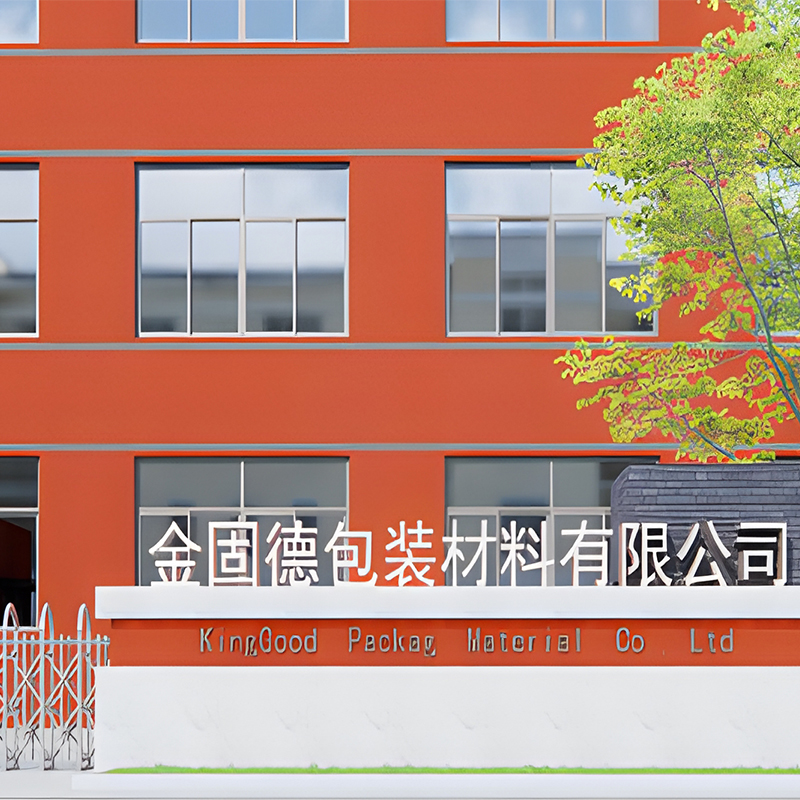 Equipment Packaging Plywood Wood Boxes Supplierinformation to be updatedView Product →
- Measure the outermost fragile point. Record length, width and height from the widest protrusion rather than from the machine base. Note every lifting point and every bolted foot, because these decide where the base beams and the blocking will sit.
- Write the transport profile. Count the transfers: factory to truck, truck to terminal, terminal to vessel, vessel to port, port to site. Each transfer is another chance for a drop, a side impact or a forklift contact.
- Fix the unit to the base before any wall is closed. Through-bolts, steel strapping or timber blocks should already prevent horizontal and vertical movement at this stage.
- Choose the enclosure and the moisture barrier. Plywood suits controlled routes, heavy-duty solid wood suits rough routes, and sea freight needs a sealed barrier regardless of the wall material.
- Document the closed crate. Photograph the bracing, the barrier and the markings. Those images become the evidence base if a claim is filed three months later.
Skipping step three is the most common failure. Crews tend to trust a thick foam layer to hold a heavy component in place, but foam manages vibration and small shocks. It does not restrain 600 kg of cast iron when a container brakes hard.
Numbers That Decide Whether a Cushion Actually Works
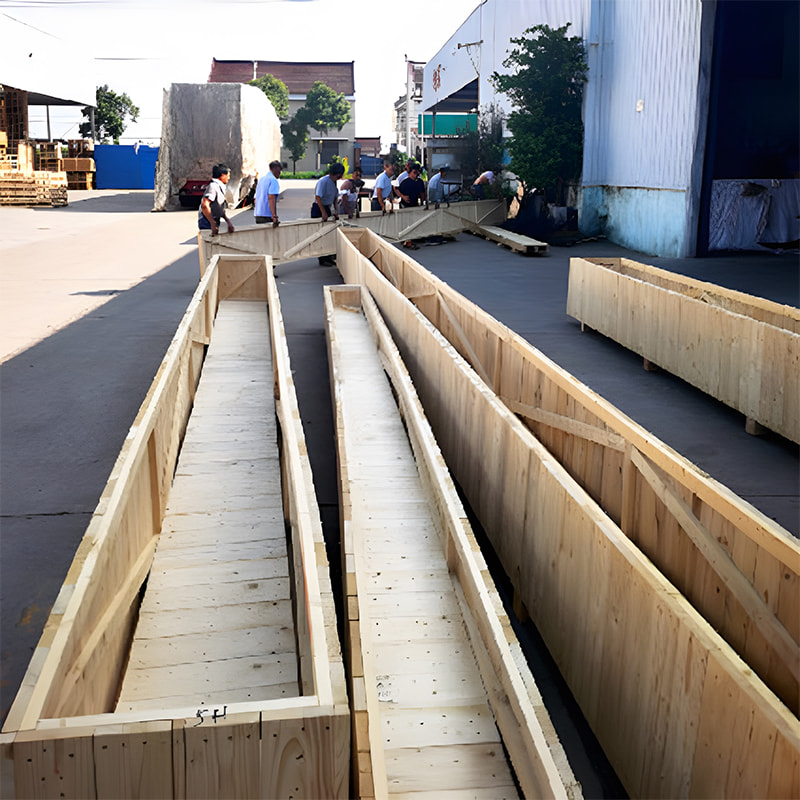 Large equipment packaging solid wooden boxDesigned specifically for heavy, oversized equipment (such as industrial machine tools, wind turbine components, large engines, and heavy machinery parts), this solid ...View Product →
A 50 to 75 mm cushioning gap around a fragile frame is a starting point for road freight, not a guarantee for a three-month sea route.
- Board moisture: export packing board is normally dried to roughly 20 percent or below before assembly. Wet board invites mould, loose fasteners and a crate that loses stiffness in transit.
- Heat treatment: solid wood packing is commonly treated at a core temperature of at least 56 degrees Celsius for 30 minutes, then marked before export.
- Desiccant load: the quantity is calculated from internal volume, surface area and voyage length. Adding a few bags by eye rarely holds humidity down through a long sea leg.
- Gross weight: crate, base, cushioning and unit are weighed together. An overweight package can be re-routed, re-priced or refused at the terminal gate.
Treat each number as a design input. When a shipment fails, the cause is usually one of these four values drifting outside the plan, not a single weak board.
Three Cushioning Techniques Worth Specifying
Block and brace instead of filling the gap
Timber blocks shaped to the machine feet, combined with through-bolts or strapping, stop the load from moving at all. Foam is then reserved for vibration and minor shocks rather than for restraint. This approach also makes unloading predictable, because the bracing sequence is visible.
Isolate fragile sub-assemblies
Control panels, glass windows, sensors and exposed shafts rarely share the same fragility as the main frame. Wrapping them in a separate inner box with its own cushioning prevents a rigid frame from transferring impact directly into a delicate part.
Control moisture as carefully as movement
Condensation inside a sealed crate can corrode machined surfaces without any visible external damage. A vapour barrier film or bag, correctly sealed and supported by sized desiccant, is often the difference between a clean arrival and a claim.
Common Mistakes and What They Cost
| What you see at the border | Likely root cause | Correction |
|---|---|---|
| Rust blooms or mould on machined surfaces | No sealed barrier during a long sea leg | Add a vapour barrier and size the desiccant to the voyage |
| Loose bolts, cracked feet, shifted components | The unit was strapped but not blocked against lateral movement | Redesign the base with timber blocking and through-bolts |
| Container held for inspection | Untreated solid wood packing with no visible mark | Use treated solid wood and apply the mark at the yard |
| Crate arrives intact, equipment is bent | Cushioning was too thin at the heaviest corner | Increase the gap at the high-mass end and spread the load |
| Damage found, claim rejected | No photos of the bracing or the closing process | Keep a photo record of every layer before the lid goes on |
Table: the five failures that appear most often in delicate equipment claims and the practical fix for each.
Pre-Shipment Checklist for Delicate Equipment
Industrial Packaging Services SupplierCustomized solutions based on cargo weight, size, material, and fragility. Standardized material processing, refined assembly and reinforcement, automated and scalable...View Product →
- Weights and dimensions verified against the packing list, including crate and base
- Lifting points marked on all four sides where the unit can actually be slung
- Bracing and blocking photographed before the walls are closed
- Moisture barrier sealed, with the desiccant count recorded on the paperwork
- Treatment mark present on every piece of solid wood packing in the load
- Opening instructions, centre-of-gravity marks and tilt indicators painted outside
Run the checklist at the crate, not at the desk. A missing mark is usually spotted in ten seconds by someone standing next to the finished box, and almost never from a spreadsheet.
Handling and Compliance Notes That Protect Your Claim
Wood packaging marks are traceable. A mark that does not correspond to a real treatment record creates a problem for the exporter, not only for the supplier. If a crate is built from a mix of treated and untreated timber, the whole consignment can be treated as non-compliant.
Keep bark and soil out of the load. Even small amounts of bark on a dunnage block can trigger a inspection request. Store finished crates under cover before loading, because a rain-soaked crate gains weight and loses stiffness before the journey has started.
On arrival, tell the receiving team not to cut the diagonal bracing until the unit is at its final position. Removing restraint while a machine is still on a forklift is a common cause of tip-over damage, and it happens after the transport risk has already been survived.
Delicate equipment packaging works when the sequence is right: transport profile, then cushioning, then enclosure, then documents. Get that order wrong and no amount of foam will compensate for a base that lets the load move.
For buyers comparing suppliers, the useful questions are concrete. Can the supplier show how the base is designed for your lifting points, how the moisture barrier is sized for your route, and how the crate is marked for your destination? King Good Packaging Materials (Nantong) Co., Ltd. publishes its crate, pallet and packaging service range on its company profile, and the wooden case marking rules are worth reading before the next export order is released.


Got Questions? Contact Us Now
-
Copyright @ King Good Packaging Materials (NanTong)Co.,Ltd. All Rights Reserved. Custom Wooden Packaging Solutions Manufacturer OEM Industrial Packaging Solutions Factory

-
Contact info.
+86-0513-88669885 +86-13813749256 13813749256@163.com Qianzhuang Village, Yazhou Town, Hai'an City, Nantong City, Jiangsu Province, China - About KINGGOOD Packaging Series Industry Solutions OEM Service News Contact