

 English
 中文简体
中文简体 Español

What is the standard industrial pallet size?
Content
- 1 The Standard Industrial Pallet Size Explained
- 2 Common Industrial Pallet Dimensions By Region
- 3 Why The 48 x 40 GMA Pallet Dominates North America
- 4 Understanding The Euro Pallet And Global ISO Sizes
- 5 Material Choices That Affect Pallet Sizing and Strength
- 6 How To Choose The Right Pallet Size For Your Operation
- 7 Common Mistakes When Sizing Industrial Packaging Pallets
- 8 Frequently Asked Questions About Industrial Pallet Sizes
- 8.1 What is the standard industrial pallet size in the United States
- 8.2 Is the Euro pallet the same size as the American pallet
- 8.3 How much weight can a standard industrial pallet hold
- 8.4 What pallet size is used for heavy machinery and industrial equipment
- 8.5 Can pallet size affect shipping cost
- 8.6 Do all warehouses need to use the same pallet size
The Standard Industrial Pallet Size Explained
The most widely used standard industrial pallet size in North America is 48 inches by 40 inches (1219mm by 1016mm), commonly known as the GMA pallet. In Europe, the standard is the Euro pallet at 1200mm by 800mm, while many Asian and heavy industrial operations rely on the 1200mm by 1000mm format. There is no single global size because pallet dimensions are shaped by regional shipping containers, truck trailer widths, warehouse racking systems, and the specific weight of the goods being moved. Choosing the correct size for a facility depends on the trade lanes served, the racking already installed, and the type of product being palletized.
Industrial Packaging Pallets are manufactured in dozens of dimensions worldwide, but a small handful of sizes account for the overwhelming majority of freight movement. Understanding these core measurements helps procurement teams, warehouse managers, and packaging engineers avoid costly mismatches between pallets, trailers, and storage racks.
Common Industrial Pallet Dimensions By Region
The table below summarizes the pallet formats most frequently referenced across freight, retail, and manufacturing supply chains. These figures reflect widely reported industry averages compiled from pallet manufacturer specification sheets and freight association guidelines.
| Pallet Name | Region | Dimensions (Inches) | Dimensions (Millimeters) |
|---|---|---|---|
| GMA Pallet | North America | 48 x 40 | 1219 x 1016 |
| Euro Pallet (EPAL) | Europe | 47.24 x 31.5 | 1200 x 800 |
| Industrial Pallet | Europe and Asia | 47.24 x 39.37 | 1200 x 1000 |
| Asia Pallet | Asia Pacific | 43.3 x 43.3 | 1100 x 1100 |
| Australian Standard | Australia | 46.06 x 46.06 | 1170 x 1170 |
| North American 42 x 42 | North America | 42 x 42 | 1067 x 1067 |
These six formats cover a large share of global freight movement, and roughly nine out of ten wooden pallets produced for retail distribution in the United States follow the 48 by 40 inch footprint according to pallet trade association reporting.
Why The 48 x 40 GMA Pallet Dominates North America
The 48 by 40 inch pallet became the North American default because it fits efficiently inside standard 53 foot trailers, matches the door widths of most warehouse racking, and aligns with grocery distribution requirements set decades ago by major retail chains.
A standard 53 foot trailer can hold 26 GMA pallets in a single layer using a straight loading pattern, or up to 30 pallets when a pinwheel pattern is used to maximize floor space. This efficiency is a major reason the format has remained the benchmark for Industrial Packaging Pallets across grocery, retail, and consumer goods distribution.
Typical Load Capacity of a 48 x 40 Pallet
- Static load capacity for a new wooden GMA pallet typically ranges from 3000 to 4600 pounds when the pallet is stationary and supported on all four sides.
- Dynamic load capacity while being moved by a forklift or pallet jack usually falls between 2500 and 3000 pounds.
- Racked load capacity, meaning the weight the pallet can hold while supported only at the edges on a warehouse rack, is generally lower and ranges from 1500 to 2500 pounds depending on the wood grade and construction.
Understanding The Euro Pallet And Global ISO Sizes
Outside North America, the 1200mm by 800mm Euro pallet is the reference point for Industrial Packaging Pallets moving through European supply chains. It was standardized to fit European rail wagons and has since become the backbone of intermodal freight across the continent.
ISO 6780 Recognized Pallet Footprints
The International Organization for Standardization lists six pallet footprints under ISO 6780 as globally recognized formats for general cargo handling:
- 1219mm x 1016mm, the North American GMA standard
- 1000mm x 1200mm, common across Europe and Asia for heavier industrial loads
- 1165mm x 1165mm, used in some chemical and pharmaceutical supply chains
- 1067mm x 1067mm, common in North American drum and chemical handling
- 1100mm x 1100mm, the dominant Asia Pacific footprint
- 800mm x 1200mm, the European Euro pallet
Because these six formats were formally recognized as international reference sizes, manufacturers producing Industrial Packaging Pallets for export generally build to one of these dimensions to guarantee compatibility with foreign racking, forklifts, and container loading equipment.
Material Choices That Affect Pallet Sizing and Strength
Pallet material selection changes how much weight a given footprint can safely carry, and it also affects the exact outer dimensions once boards and blocks are accounted for.
Wood Pallets
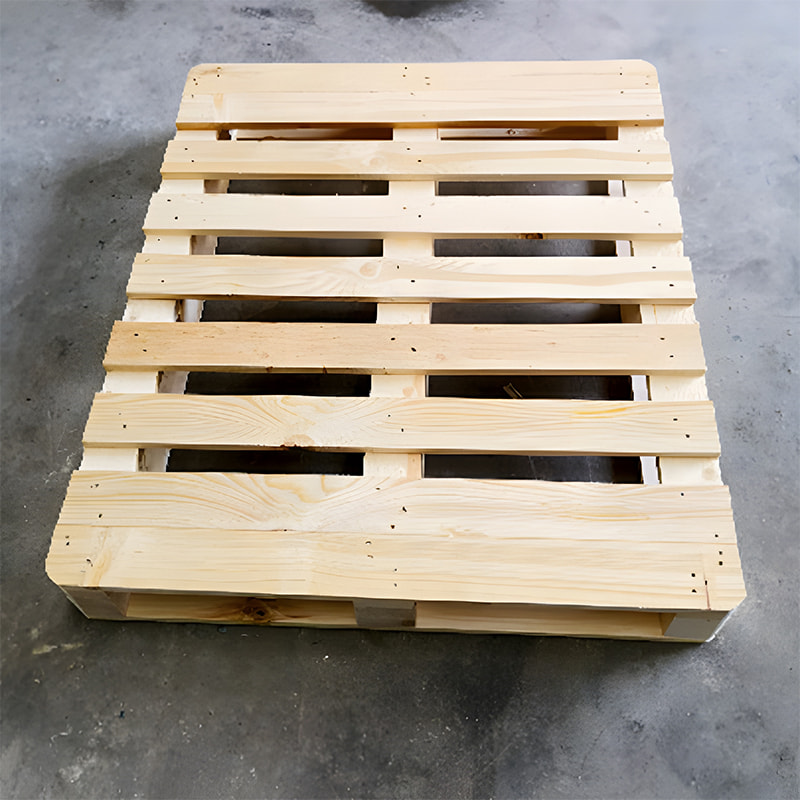
Wood remains the most common material for Industrial Packaging Pallets because it is inexpensive, repairable, and widely recyclable. Softwood pallets are lighter but less durable, while hardwood pallets cost more yet withstand repeated handling in closed loop systems.
Plastic Pallets
Plastic pallets hold consistent dimensions because they are molded rather than assembled from boards, which makes them attractive for automated warehouses that rely on tight racking tolerances. They resist moisture and pests but carry a higher upfront cost.
Metal Pallets
Steel and aluminum pallets are used for extremely heavy loads or high heat environments such as foundries. They are the heaviest option but offer the longest service life and highest load capacity relative to their footprint.
Presswood and Corrugated Pallets
Lightweight presswood and corrugated paper pallets are increasingly used for air freight and export shipments where weight restrictions and one way use make wood or plastic pallets less economical.
How To Choose The Right Pallet Size For Your Operation
Selecting the correct dimension among the many available Industrial Packaging Pallets formats comes down to matching the pallet to the racking, trailers, and product footprint already in use.
Key Factors To Evaluate
- Measure the existing rack beam spacing before ordering a new pallet size, since a mismatch can create unsafe overhang or wasted rack space.
- Confirm the trailer or container type used most often on your primary trade lane, as ocean containers and domestic trailers favor different footprints.
- Account for the heaviest single unit load expected, then select a static and dynamic load rating with a safety margin above that figure.
- Check whether trading partners or retail customers specify a required pallet footprint as part of their receiving standards.
- Weigh the tradeoff between a one way pallet, which is lighter and cheaper per unit, against a reusable pallet designed for a closed loop pooling system.
Common Mistakes When Sizing Industrial Packaging Pallets
Mixing incompatible footprints in the same racking bay is one of the most frequent errors, causing beam overhang and unstable stacking that raises the risk of load collapse.
Ignoring trailer cube utilization leads to wasted trailer space when a pallet footprint does not divide evenly into the trailer width, increasing freight cost per unit shipped.
Underestimating racked load capacity by assuming static load figures apply on a rack, when in practice racked capacity is meaningfully lower because support only comes from the two edge beams.
Frequently Asked Questions About Industrial Pallet Sizes
What is the standard industrial pallet size in the United States
The standard industrial pallet size in the United States is 48 inches by 40 inches, also called the GMA pallet, which is used for the large majority of retail and grocery distribution.
Is the Euro pallet the same size as the American pallet
No. The Euro pallet measures 1200mm by 800mm, which is narrower and longer in proportion compared to the 1219mm by 1016mm American GMA pallet, so the two are not interchangeable inside the same racking system without adjustment.
How much weight can a standard industrial pallet hold
A new wooden 48 by 40 inch pallet typically holds between 3000 and 4600 pounds under static conditions, though the exact figure depends on wood grade, deck board spacing, and whether the load is supported on the floor or on a rack.
What pallet size is used for heavy machinery and industrial equipment
Heavy machinery often ships on the 1200mm by 1000mm industrial pallet or on custom built skids because the larger footprint and reinforced stringers provide better support for concentrated point loads.
Can pallet size affect shipping cost
Yes. A pallet footprint that does not divide evenly into a trailer or container width leaves unused floor space, which reduces the number of units shipped per load and raises the effective freight cost per pallet.
Do all warehouses need to use the same pallet size
Not necessarily, but standardizing on one or two footprints across a facility significantly reduces racking conflicts, simplifies forklift training, and lowers the chance of unstable mixed stacking during storage.


Got Questions? Contact Us Now
-
Copyright @ King Good Packaging Materials (NanTong)Co.,Ltd. All Rights Reserved. Custom Wooden Packaging Solutions Manufacturer OEM Industrial Packaging Solutions Factory

-
Contact info.
+86-0513-88669885 +86-13813749256 13813749256@163.com Qianzhuang Village, Yazhou Town, Hai'an City, Nantong City, Jiangsu Province, China - About KINGGOOD Packaging Series Industry Solutions OEM Service News Contact